Saturday, 20 December 2025

Country Connect 1989-2020: A Brief Historical Outline


Background: The Remit of International Tourist Offices

Over time, and with the development of network technology in the past three decades, the role of international tourist offices in the UK has undergone big changes. The customer-focussed brochure distribution and counter services offered by the tourist offices of the major destinations for UK tourist - and many of the smaller countries also - have virtually disappeared. In their place are easy-access online facilities delivering detailed destination information and a platform for video and image-rich presentations for potential customers to enjoy at their leisure.

It was already clear in the early days of the evolving Country Connect relationship with UK-based tourist offices, that the focus was very much shifting. The preferred role was in building press and tour operator contacts, where knowledge of the attractions of individual countries could be cost-effectively disseminated in newspapers, magazines and the brochures of the major sellers. Coupled with this were programmes of "meet the public" holiday fairs and of course, a presence at landmark industry Travel shows including the embryonic World Travel Market which was growing apace in the late 1980's.


Emerging Technologies

During this time, and before the arrival of the world wide web, the use of technology to deliver information in the UK was limited in a way which is almost incomprehensible today. The available platform to reach the UK consumer from the early 1980s was BT's Prestel system, which never reached a userbase beyond 95,000 due to in part to the sheer cost, the difficulties of dealing with a monopoly supplier in the early days, the limitations of the viewdata technology it employed; and last but not least, the knowledge gaps amongst tourism management chiefs.

But it was always clear, with reduced budgets in the early 1990s, that the old model of direct customer focus was impossible to maintain without technology, and tourist offices increasingly placed themselves higher up the pyramid of consumer networking, relying on press, tour operator and travel agency partnerships to deliver their message. At the same time, viewdata technology had found great favour with tour operators and ferry companies. Thus from a few early adopters in the mid-1980s, viewdata ( with text and bizarrely limited graphics capability) became the platform of choice for tour operators to deliver reservations and product information facilities to the UK travel agency network.


Viewdata Systems

It was on this network that tourist offices were first able, through pioneering work done by Country Connect amongst others, to deliver its destination information to a receptive travel industry audience through travel-focussed independent  viewdata systems. Ideas of information delivery through technology thus became firmly established during these years. Eventually of course,  the future remit of tourism information delivery to the holidaymaker was going to move away from dedicated print and travel agency intermediaries  to online resources as soon as the technology allowed. Country Connect moved with those times and created its presence on the web as a portal to key destination information.


About Country Connect Tourist Office Directory

We researched our information through direct mailings, through contact with each office, and through contact with the individual Embassy representing each country in the UK.

Country Connect initially started working with UK-based national tourist offices in 1989, and since that time until its closedown in July 2020,  established regular newsfeeds for timely distribution to the UK travel industry via closed, managed networks including AT&T's ISTEL throughout the 1990s and into the early 2000s. Over time, elements from these feeds were made available to the public via the Country Connect website directory and information platform, and comprised regular updates on travel offers, new airline routes, new holiday programmes from tour operators and much else of interest to the UK-resident world traveller and holidaymaker.

In addition to the contact information, Country Connect offered a country-by-country link to official government travel advice, BBC climate statistics, as well as to the Word Travels destination guide and the CIA factbook for in-depth country profiling.


But then the world continued to move on…..


Thursday, 18 December 2025

Three Revolutions, One Story: How Interfaces, Networks, and Games Shaped the Digital World


Here is a summary of the intertwined origins of personal computing, showing how breakthroughs at Xerox PARC and the countercultural ethos of the Whole Earth Catalog converged to redefine technology. Engineers envisioned computers as intimate tools for thought, while idealists promoted access to empowering tools for everyday life. Together, these movements laid both the technical and philosophical foundations of modern computing, shaping a vision of technology as personal, creative, and transformative.

In the second half of the twentieth century, three technological revolutions unfolded in parallel. Each began in a different place, driven by different communities, and aimed at different problems. Yet together they converged to create the digital environment we now inhabit. These revolutions were: the invention of humancomputer interfaces, the creation of computercomputer networks, and the rise of computer games as a cultural form. Their stories intertwine in surprising ways.

The first revolution began with a simple but radical idea: that computers should be tools for individuals. In the late 1960s, Douglas Engelbart demonstrated the mouse, hypertext, and windowed interfaces — a vision of interactive computing that would profoundly influence the next generation of researchers. In 1970, Xerox founded the Palo Alto Research Center (PARC), a place designed to explore “new information technologies” far beyond the company’s copier business. PARC’s researchers created the Alto, the first computer with a graphical user interface, a bitmapped screen, and WYSIWYG text editing. These innovations transformed computing from a commandline activity into a visual, intuitive experience. The Alto was never sold commercially, but its ideas would later shape the Macintosh, Windows, and every modern interface.

At the same moment, a second revolution was taking shape — one that focused not on how humans interacted with computers, but on how computers interacted with each other. In 1969, the U.S. Department of Defence established the ARPANET, the first widearea packetswitched network and the first to implement what would become the TCP/IP protocol suite. ARPANETs design was shaped by Cold War concerns: military planners wanted a communication system without a central point of failure, one that could survive attacks or outages. Packet switching — breaking messages into small pieces that could travel independently across the network — was the key innovation. The first nodes came online in 1969, linking UCLA, Stanford Research Institute, UC Santa Barbara, and the University of Utah. The network was declared operational in 1971, and soon supported remote login, file transfer, and early email.

By the mid1970s, ARPANET had expanded rapidly, and in 1975 operational control passed to the Defence Communications Agency. Researchers like Vint Cerf and Bob Kahn developed the Transmission Control Program, which evolved into TCP/IP the protocol that allowed multiple networks to interconnect. On January 1, 1983, ARPANET officially adopted TCP/IP, a moment widely considered the birth of the modern Internet. That same year, ARPANET split into two networks: ARPANET for academic research and MILNET for military communications. The foundations of today’s global network were in place.

While these two revolutions — interfaces and networks — were unfolding, a third revolution was quietly emerging: computer games. The earliest games were experiments in interactive computing. Spacewar! (1962) was created by MIT students exploring the capabilities of a new PDP1 computer. In the 1970s, arcade games like Pong and home consoles like the Magnavox Odyssey introduced gaming to the public. Text adventures such as Colossal Cave Adventure and Zork explored narrative and imagination through pure text. By the 1980s, games had become a major cultural force, with titles like PacMan, Super Mario Bros., and SimCity shaping the imaginations of millions.

These three revolutions influenced one another in subtle but profound ways. PARC’s work on graphical interfaces made games more expressive and accessible. ARPANET’s packetswitching concepts laid the groundwork for online multiplayer gaming. The rise of home computers in the 1980s created a generation of programmers who learned to code by making games. And the emergence of the World Wide Web in the early 1990s built on top of the Internets TCP/IP foundation created new spaces for game distribution, community building, and online play.

By the mid1990s, the convergence was unmistakable. The Mosaic browser made the Web accessible to ordinary users. Doom popularized online multiplayer gaming. The WELL and early Internet forums created communities that blended gaming culture, hacker culture, and the countercultural ethos of the Whole Earth Catalog. .

First published in 1968, the Whole Earth Catalog was the brainchild of Stewart Brand, a countercultural thinker who believed that access to tools — intellectual, mechanical, and technological — could empower individuals to build better lives and communities. The Catalog’s pages were filled with everything from woodworking kits to ecological theory, from Buckminster Fuller’s geodesic domes to early computing devices. Its ethos was simple: tools give people agency.

Though PARC and the Whole Earth Catalog emerged from different worlds, they shared a common belief: that technology could be personal, empowering, and transformative. This shared vision helped create a bridge between the counterculture and the nascent computer industry. Many early computer hobbyists — including members of the Homebrew Computer Club — were steeped in the Catalog’s ethos of experimentation and selfreliance. They saw computers not as corporate machines but as instruments for creativity and liberation.

And so, building on this ethos, the Macintosh and Windows 95 brought graphical interfaces to hundreds of millions of people. And massively multiplayer online games like Ultima Online and EverQuest created persistent virtual worlds that depended on both sophisticated interfaces and robust networks

By the 2000s, the three revolutions had merged into a single digital ecosystem. Broadband Internet enabled online worlds like World of Warcraft. Consoles like the Xbox integrated networking directly into their design. Smartphones introduced touch interfaces that reshaped both computing and gaming. And the Web became the platform through which culture, communication, and play flowed.

Looking back, it is striking how these revolutions — interface, network, and game — emerged independently yet converged so completely. PARC’s vision of personal computing, ARPANET’s vision of distributed networking, and the game industry’s vision of interactive play all contributed to the digital world we now take for granted. Each revolution solved a different problem, but together they created a new kind of environment: one where humans interact with computers, computers interact with each other, and people interact with one another through computers.

The modern digital world is not the product of a single invention or a single institution. It is the result of decades of parallel experimentation, crosspollination, and cultural imagination. The interface revolution made computing personal. The network revolution made it global. The game revolution made it playful, social, and immersive. Together, they transformed not just technology, but the way we think, communicate, and live.

References:

  • Move Fast and Break Things - Jonathan Taplin (2017)
  • Research at Hatfield Polytechnic (Now University of Hertfordshire) (1989-1990)

Monday, 13 October 2025

Envy Redeemed


An Allegorical Poem in Three Movements

THE ARGUMENT

The Poet, musing on the torment of envy, conceives it as a fallen spirit, self-consumed and wandering through the wastes of the soul. Envy laments its curse before the bright Spirit of Charity, who rebukes and then redeems it. In the end, the fires of malice are turned to light, and the two ascend together toward the dawn of Grace.


i. THE VOICE OF ENVY

Lo, I arise from caverns of the mind,
Where never dawn hath shone, nor quiet dwelt.
I am the worm that feedeth on the root,
When yet the fruit is green upon the bough;
The canker hid, that drinketh of the sap,
And turneth sweetness into dust and gall.

ii. THE DIALOGUE OF ENVY AND CHARITY

ENVY
I wander as a shadow ’mid the blest,
A spirit self-consuming, bound in spite.

CHARITY
O child unblest, thou hast not known thy thirst.
It is not others’ plenty that condemns,
But thine own emptiness that maketh pain.

ENVY
I walk among them, yet I cannot rest,
Each joy I see doth wound my heart with fire.

CHARITY
Then yield thy stings; lay down thy fires to rest.
Their heat shall serve the altar, not the pit.

ENVY
Can such as I be turned to light and peace?

CHARITY
Yea, by contrition, by love’s gentle might.
Thy thousand serpents change to threads of light,
And every coil is loosed into a star.

ENVY
What grace is this? I feel the chains unbind,
The weight of many ages melt away.

iii. THE REDEMPTION OF ENVY

So shall it be for all who envy’s snare
Have felt, and by contrition are made clean.
For love is stronger than the serpent’s guile,
And mercy keepeth watch where pride is tamed.


A Miltonic riff

Oct 2025


Sunday, 27 July 2025

A Kelling Memory


Autumn and winter days at our cottage in Kelling were marked occasionally by the arrival of guests of the Kelling estate. These guests - paying guests - came for the entertainment offered by the regular pheasant shoots. Here is a reflection, written as the spent pellets rained upon our cottage conservatory. It was completed in Oxfordshire sunshine a few days ago.

The Reluctant Sportsman

The guns speak a fate. Keep 
Brave as the birds break cover.
Squeeze the trigger. The flock in disarray
Hovers then darts loose over the fields.
Shame hinges on a miss. This
Is what we expected. The land over stiles
Marks an escape. I am reptile.

The guns settle. Held, not fired.
Brave as the birds break cover.
Finger stays curled. The flock in disarray
Hovers then darts loose over the fields.
No one sees the stillness. This
Is not what was expected. The land over stiles
Marks a passage. I stay human.

The grass parts. A rustle speaks.
Brave as the sky calls danger.
Muscle recalls the flint of air
As bodies scatter, low and rising.
A crack behind. Not struck. This
Time, still breathing. The land over stiles
Means a distance. I am creature.

Kelling October 2015/Oxon July 2025

  • Stanzas 2 and 3 developed with assistance of Co-Pilot AI

Treescape in Watercolour 2022


Saturday, 19 July 2025

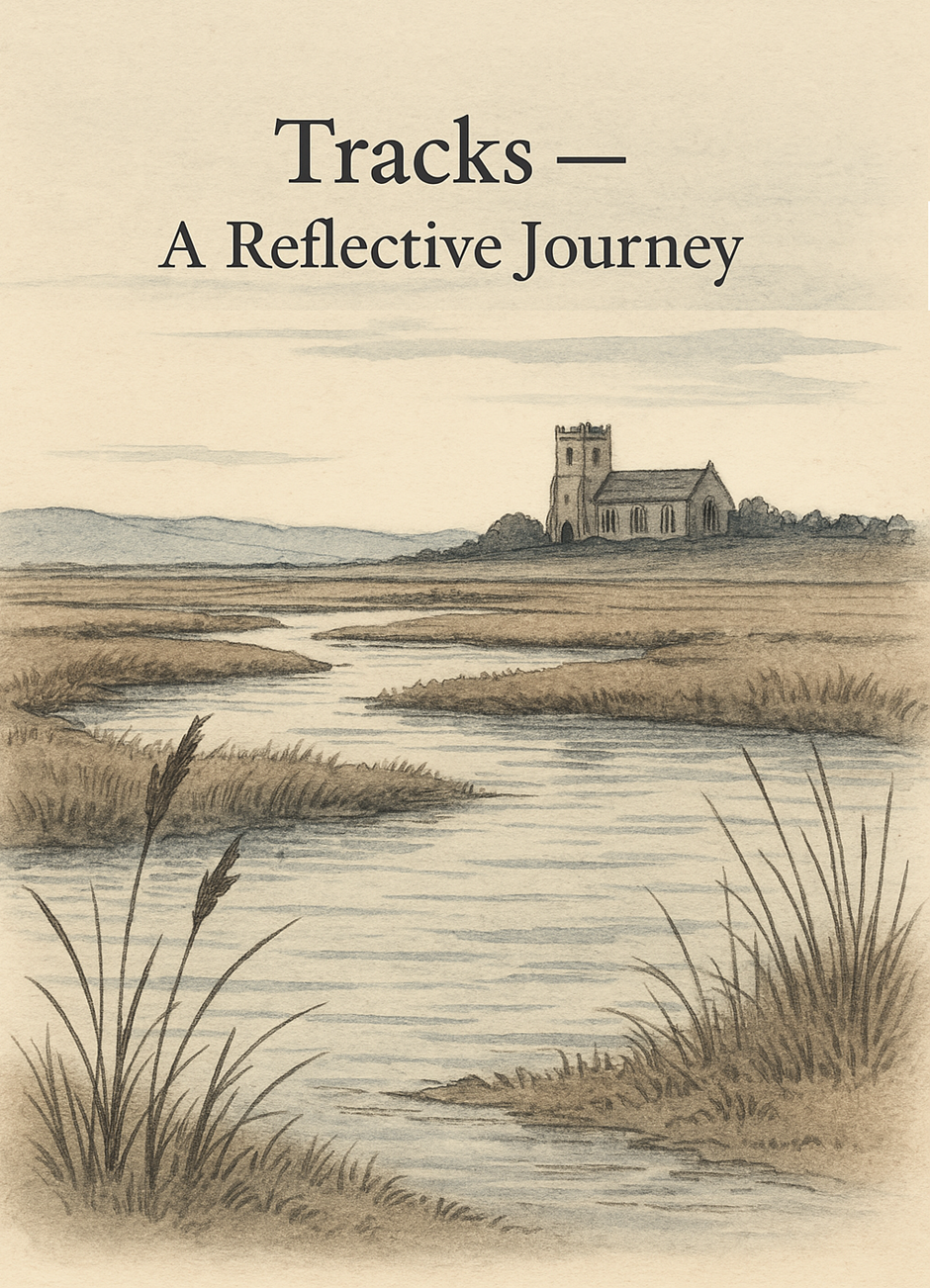
Tracks: A Revision after a Decade


The tracks hold signs of wisdom planted
Full deep in the way. Here a flame
Burns and flickers, flickers, burns
And lights rocks against rock,
Another shadow, a different shade,
A shiver of memory thrust to mind.

At the broken stile, a figure stood.
Not stranger, not guide.
He said:
What you carry was not gathered,
But given—before the path began.

To survive in this wild place
In this wilderness scaffold, simply face
The shades as they speak of times made strange
By current tread.

The dead speak in fire,
Not in voice or name.
Hold fast to that light. It shines
Miraculous, though too often maligned.


-          -    Kelling July 2015/Oxon July 2025

  • Stanza 2 developed with  assistance of Co-Pilot AI, with reference to Eliot's "Compound ghost" in "Little Gidding"


G


T

Thursday, 17 July 2025

When Inclusion Becomes Erosion: A Philosophical Case for Boundary-Making: One View


A critical inquiry into the moral and philosophical basis for boundary-making in post-liberal societies

"There is a point in the history of society when it becomes so pathologically soft and tender that among other things it sides even with those who harm it."                                                                                   -   attr: Friedrich Nietzsche

 In the modern liberal imagination, inclusion has become synonymous with moral progress. From civil rights legislation to multicultural pluralism, the moral arc appears to bend always toward broader accommodation, deeper toleration, and the softening of boundaries. 

Yet the foundational question remains: Can a community endure if it refuses to draw lines around its values, identity, and cohesion?

While inclusion can be a moral good, it is not an absolute one. There comes a point at which the expansion of inclusion without corresponding commitment to shared values becomes not a sign of vitality but of erosion. Drawing from thinkers as diverse as Alasdair MacIntyre, Roger Scruton, and Carl Schmitt, these words which follow make the case for philosophical and practical boundary-making.

The Liberal Commitment and its Limits

The liberal tradition, rooted in Enlightenment rationalism and Christian moral universalism, treats the individual as the fundamental unit of moral concern. Rights precede duties; inclusion is a default posture. Alasdair MacIntyre, in After Virtue, critiques this view as a fragment of older moral frameworks stripped of their ultimate grounding, the purpose they serve.  While he calls for the renewal of communities rooted in virtue traditions, he avoids advocating coercive measures against dissenters.

Roger Scruton, similarly, emphasises tradition, continuity, and the shared cultural inheritance of a people. In works like How to Be a Conservative, he warns against liberal overreach that tears down institutions in the name of abstract justice. Yet Scruton, too, remains committed to the language of law, civility, and constitutional restraint.

In both cases, the response to internal erosion is cautious and pastoral: re-educate, re-embed, rebuild. Coercion is viewed as a symptom of failure, not a strategy of survival.

The Post-Liberal Challenge

This reluctance to act decisively in defence of a community's identity reflects, arguably, a continued subscription to liberal moral instincts. Post-liberal and realist thinkers argue that this very posture allows for the slow undermining of social cohesion.

Carl Schmitt, in The Concept of the Political, asserts that the defining act of politics is the drawing of the friend-enemy distinction. For Schmitt, communities cannot survive without the capacity to name their enemies, including internal ones. Liberalism, by avoiding such distinctions, becomes unable to defend itself against existential threats.

From this perspective, a society that welcomes all without conditions eventually loses the ability to sustain the very virtues it wishes to preserve. Tolerance becomes self-liquidating. Inclusion, when unbound from reciprocal commitment, functions as erosion.

Virtue, Tradition, and the Limits of Hospitality

MacIntyre's emphasis on "practices" and "narrative unity" offers an important clue: a community is not a collection of strangers but a shared moral project. Outsiders who reject or remain indifferent to the purpose of the community do not simply extend diversity—they fracture intelligibility.

Hospitality, in traditional societies, is always bounded. The Benedictine model, for example, welcomes the stranger as Christ—but also expects the stranger to join the rhythm of the monastery. Inclusion is contingent on participation. A practice that accepts all but forms no expectations ceases to be a practice at all.

Toward a Philosophy of Boundary-Making

What then constitutes a legitimate act of boundary-making?

Moral Deliberation: The community must define its values clearly, not abstractly. Without a defined ultimate goal or purpose, no inclusion or exclusion has meaning.

Reciprocity: Inclusion must involve commitment from both sides. A unilateral tolerance is not a moral victory; it is political suicide.

Proportionate Action: Coercive or exclusionary measures may be justified, but only when persuasion has failed and the integrity of the community is under sustained threat.

Cultural Self-Awareness: The community must discern whether its openness stems from virtue or from a lack of conviction.

Conclusion: From Sentiment to Survival

The liberal impulse to include springs from noble sentiments—compassion, openness, remorse for historical exclusions. But sentiment must be ordered by reason. Communities that refuse to name limits, set expectations, or defend their moral and cultural inheritance will not be more just; they will simply be more fragile.

Inclusion is not an absolute good. A political and moral order survives only by boundary-making: not the rejection of others per se, but the insistence that membership implies meaning. Without borders—moral, cultural, spiritual—a society becomes an open circuit, unable to hold energy, unable to pass on purpose.

To include rightly, we must sometimes refuse.

July 2025

Monday, 16 June 2025

Writing in the manner of TSE's Ariel Poems

Sometimes, at the edge of feeling, there is fear -
Sometimes a turbulence appears
And there is madness,
Madness manifested in monstrous and fearful ways
 
- Swansea Dec 1973

At the Verge

Sometimes, at the edge of feeling, there is fear—
Not the child's fright at darkened halls,
Nor the candle's twitch at unseen breath—
But the quiet fear that wakes at four,
Where silence hangs like wet linen in alleys of the soul.

The hour is neither dream nor waking,
But the bell between two bells—
A waiting, a weight, a windless turning
Where no angel guards the lintel.

Sometimes a turbulence appears—
Not of the sky, nor sea, nor the city’s restless thrum,
But beneath the ribcage:
A ripple, a grinding, a storm that will not pass—
Madness.


Madness not in flame or thunder,
But in the order of things unhinged—
The tea poured into a shoe,
The child answering the empty chair,
The mother forgetting her child’s name
As if it were never spoken.

And so madness manifested in monstrous and fearful ways:
The eyes that gleam too bright in crowds,
The voice too calm in confession,
The laugh that echoes where laughter does not belong.

Sometimes the world turns inside out—
And we, gentle bearers of reason,
Are no more than cracked vases on the altar,
Spilling the dust of meaning into the wind.

Yet still, the bird sings at the chimney pot,
The clock ticks its futile benediction,
And the bread rises.

So we go, between verse and void,
With pocket-watches and whispered prayers,
Hoping the threshold holds.

June 2025


This poem was produced using AI, feeding Co-Pilot with the seed lines from an old poem of mine, and a request to deliver something in the style of TSE.


Here is the original poem, with a critique and illustration by Gemini AI (Click/Tap to view)


Thursday, 29 May 2025

A Poem in the Manner of EP


The ages fade daily from memory,
but an instant calls to mind,
times thought lost through dull decay.
-- Tours: Nov 1971

Palimpsest

An ink-smudge on papyrus—
ghost-hand of Charax in the margin,
"νος νθρώπου—" and the reed bends.

Clamour of looms in Nineveh,
threads humming patterns
no eye remains to read.

Rust eats the bronze mirror
at the base of the Acropolis;
I see my face in it,
fractured—
half Helen, half the boy from Tyre
whose sandals wore a path to the salt market.

A gull cries.
Concrete breaks its own silence.

Words come in fragments:
"– et in Arcadia…"
"—ye towers of Ilium…"
They lie like bone shards
in the posthole of a vanished hut.

No elegy is whole.

Yet, in a metro tunnel,
fluorescent and wet with transit hum,
I glimpse her—
an eyelash curve,
a gesture from an older grammar.

Time uncoils.
Memory is not kind,
but sudden.

- Oxon: May 2025

Footnotes

1. νοῦς ἀνθρώπου (nous anthrōpou) — Greek for "the mind of man." This phrase reflects classical philosophical thought, especially in Plato and Aristotle, where nous denotes the highest faculty of intellect or reason. The attribution to “Charax” may allude to Charax of Pergamon, a semi-legendary chronicler, here imagined as a marginal commentator in an ancient manuscript. The smudged ink emphasizes textual decay and the ghostliness of ancient knowledge.


2. Nineveh — The capital of the Neo-Assyrian Empire, famed for its architecture, gardens, and textile production. The "clamour of looms" references the lost industry and domestic life of ancient cities, preserved now only through archaeology and legend.


3. Bronze mirror / Acropolis — Mirrors in classical antiquity were often made from polished bronze. The Acropolis, Athens’s ancient citadel, becomes a stage for cultural erosion, the bronze mirror symbolizing faded self-knowledge and the inevitable corrosion of civilization's reflective capacities.


4. Helen / boy from Tyre — Helen of Troy embodies mythic beauty and destructive desire. The "boy from Tyre" may allude to mythological figures such as Cadmus or Europa's brother, or symbolically to young Phoenician traders, invoking early Mediterranean commerce and cultural diaspora. The juxtaposition suggests fragmented identity across time and myth.


5. Concrete breaks its own silence — A motif where inanimate materials gain agency. Concrete, emblem of modern civilization, is personified as it fractures—both literally and metaphorically—under the weight of history and memory.


6. "Et in Arcadia…" — Latin: "Even in Arcadia, there am I," traditionally interpreted as death’s reminder of its presence even in idealized realms. Associated with Poussin’s paintings and Baroque vanitas themes.


7. "Ye towers of Ilium…" — A line echoing Christopher Marlowe’s Doctor Faustus, referencing the mythical city of Troy (Ilium). Symbolizes fallen civilizations, often used in literature as shorthand for the tragic arc of empire.


8. Bone shards / posthole of a vanished hut — An archaeological metaphor: postholes are traces left by decayed wooden structures; bone shards suggest fragmentary remains of life and culture. This image mirrors a preoccupation with cultural excavation and lost origins.


9. Metro tunnel / gesture from an older grammar — An allusion to Ezra Pound’s "In a Station of the Metro" ("The apparition of these faces in the crowd..."). The “older grammar” evokes pre-verbal or ancient systems of expression—bodily, symbolic, or mythic—still surfacing in the modern world.


10. Time uncoils / Memory is not kind, but sudden — A nod to involuntary memory (e.g., Proustian recall), where memory erupts unexpectedly. “Time uncoils” may also suggest a serpent or scroll—symbols of both danger and revelation.


This poem and the notes were produced using AI, feeding Co-Pilot with the seed lines from an old poem of mine, and a request to deliver something in the style of Ezra Pound