Saturday, 29 July 2017

Raphael: Massacre of the Innocents

 Coincidentally, the day before the 100th anniversary of Paschedale, we visited the exhibition of drawings by Raphael at the Ashmolean Museum. These cartoons were well-described by experts who now know in great depth, how they emerged from various iterations on the paper by use of electronic screening and scanning processes.

Raphael: Massacre of the Innocents

Most affecting for me in terms of subject matter was No 70: a line drawing of "Massacre of the Innocents", the subject being the attempt by Herod to destroy all the male children in Bethlehem in an attempt to destroy the infant Jesus. The image had sharply defined short lines building up to the shapes of limbs, hands, arms and a composition of dramatic action which defied easy analysis. Simply speaking, a stark build-up of an emotional drama, made more vivid by the sense of an event encapsulated in a scratched-out moment of incompleteness, snatched out from a moment in time.

From the exhibition description: A woman is running towards us, mouth open in a scream, a baby cradled in her arms. The violence around her seems to part and give passage through the slaughter. What the open pathway through the heart of the horror really gives however, is a heartbreaking visual connection between our eyes and her pain. To look into that terrified face is to feel the full pity of her plight. It is impossible not to be gripped by an overwhelming compassion.

Paschendale Remembered: July 29th 2017

New every morning is the Love.
Paschendale remembered in the News:
It has been a hundred years since, but
There is the danger of the flaccid mind
As if those horrors were left behind.
Tell this to the people of Mosul,
Tell this to the people of Yemen.
Let us not be fed with too-comfortable methodologies
To tickle the sentimental core.
                                                                  - DB July 2017


Saturday, 26 March 2016

Woollen Shrouds: A Grave Case of Closed Shop Practices


Start of the Easter Story Sequence:  South Newington
Occasionally it happens that an oddity emerges during a visit to any number of the churches I come across in my increasingly unstructured attempts to understand more about these buildings. The church of St. Peter ad. Vincula in South Newington near Banbury was and is no exception. I expected to see its marvellously-preserved wall paintings and was not disappointed. They are sometimes breath-taking in their detail, and have clearly been the subject of a great deal of care and skill to keep them as they are today.

Madonna & Child
South Newington
Martyrdom of Thomas Becket
South Newington


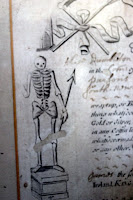
But what caught my eye among all this medieval ecclesiastical finery, were a set of small, framed black-and-white documents on the wall of the north aisle. These turned out to be 17th and 18thcentury certificates of "burial in shrouds made of wool". These rather macabre documents recall a period when it was a legal requirement to bury the dead in woollen shrouds, and of no other material.

Burial in Wool Affidavit: South Newington
The certificates are decorated with symbols of death and mortality, including hourglasses, skeletons, coffins, a scythe, arrow, and bodies wrapped in shrouds.

The Burial in Woollen Acts 1666-80 were Acts of the Parliament of England which required the dead, except plague victims, to be buried in pure English woollen shrouds and never any foreign textiles. The driver for this restrictive practice was the perceived and real decline of the woollen industry throughout England. For centuries the woollen trade had been important to the wealth and prosperity of the country, but with the introduction of new materials and foreign imports, the wool business was under threat.


So, the idea was to create and to protect a new market for woollen cloth. It was a requirement that an affidavit be sworn in front of a Justice of the Peace (usually by a relative of the deceased or some other credible person) confirming burial in wool, with the punishment of a £5 fee for noncompliance.  Parish registers were marked with the word affidavit or with a note 'A' or 'Aff' against the burial entries to confirm that affidavit had been sworn, or marked 'naked' for those too poor to afford the woollen shroud. 


The declarations included the words:  "No corpse of any person (except those who shall die of the plague) shall be buried in any shift, sheet, or shroud, or anything whatsoever made or mingled with flax, hemp, silk, hair, gold, or silver, or in any stuff, or thing, other than what is made of sheep’s wool only."

Failure to comply meant a fairly hefty £5 fine. Half of this money was paid to the informer. The other half was handed over to the Poor Fund of the parish where the body was buried. Within 8 days of the burial, an affidavit had to be provided declaring that the burial complied with the Act. The affidavit had to be sworn in front of a Justice of the Peace or Mayor by two worthy persons. If the parish did not have a JP or Mayor, the parson, vicar or curate could administer the oath.


This Act was obviously unpopular with many people as they wanted to buried in their finery as opposed to a cheaper garment or shroud in an off-white colour and of very thin material. And so here's a trick... Many were prepared to pay the £5, and a member of a family would become an informer so that in effect only half of the fine would be paid.


This concern at being buried in wool can be found ridiculed occasionally in literature.


"Harkee, Hussy, if you should, as I hope you won't, outlive me, take care
 I ain't buried in flannel; 'twould never become me, I'm sure.
Richard Steele: The Funeral, a play 1700.


"‘Odious! in woollen! 'twould a saint provoke!’
(Were the last words that poor Narcissa spoke).
 'No! let a charming chintz and Brussels lace
 Wrap my cold limbs, and shade my lifeless face"
 Pope: Moral Essays, Ep. I.


Narcissa was a Mrs. Oldfield, an actress, who died 1731. Pope wrote this after reading that she was buried in "a Brussells lace head dress; a Holland shift with tucker and double ruffles of the same lace, and a pair of new kid gloves."


The Act was repealed in 1814, but was generally ignored after 1770.

Thursday, 25 February 2016

Island Records - Portrait of an Iconic Label

Artists such as U2, Roxy Music, Jethro Tull, King Crimson, Bob Marley and - initially and exceptionally: Millie Small - all have one major, creative platform in common - a unique record label founded in 1959. This record label, in spite of being swallowed up 20 years ago by Polydor and subsequently enveloped into the Universal brand, remains a byword for independent creativity. This was Island Records, founded in Kingston, Jamaica by Chris Blackwell and despite a modest beginning pressing discs on borrowed equipment at a nearby radio station and scratching together some office space on a tiny budget, the business grew following a move to London in 1962, bringing with it a consolidation of the new wave of ska and American R&B which lit a fuse in drab late-fifties / early 60's Britain.

Historians will say of course, that it was with the Beatles and the Mersey Sound, that popular music suddenly woke up to itself after the initial flush of Mid-50's Rock & Roll had long since waned into a balladeering wasteland and a renewed mish-mash of tame hybrid styles geared to "family entertainment" - and of course there is no doubt that that the early Mersey sound crashed through all this big-time. But this was also a period of a massive cross-fertilisation of styles, and for Island Records, the first big event was to achieve a crossover for ska music into the mainstream via a crackling, populist yet unquestionably "different" sound - Millie Small's "My Boy Lollipop" - a smash hit in 1964 and a harbinger of things to come in terms of breaking new acts with styles which were uniquely ahead of the curve of what was acceptably mainstream.

Thus 3 years after this, Island was focussing on Blues-based rock music / psychedelic folk crossovers from a crop of white musicians including the extraordinary John Martyn as well as Free (a major act of the festival circuit), Spooky Tooth and Stevie Winwood's Traffic. Later came progressive bands such as King Crimson and Jethro Tull featuring a demonic Ian Anderson fronting up with that archetypal rock music instrument - the flute!

By the late 60's the label was signing a wave of eclectic folk acts including Dr Strangely Strange, Nick Drake and Fairport Convention - each hugely individual and influential - and shortly afterwards adding a strand of art-pop to the mix, via Bryan Ferry's Roxy Music.

But of course, it does not stop there. Moving back to its Jamaican roots, the label signed a band locally feted in hometown Jamaica called Bob Marley and the Wailers. Convinced that they had found a "black rock star as big as Hendrix", according to Chris Blackwell, Island Records invested heavily on his instincts and produced Marley's first album "Catch a Fire". History was made. Soon, Bob Marley was to become Island Records' biggest selling act.

Following this reassertion of reggae as a musical force, many reggae acts followed, including Burning Spear, Toots and the Maytals and Steel Pulse. But alongside these were also Robert Palmer, Grace Jones and Tom Waits - and more tellingly, from the Dublin connections which started with Dr Strangely Strange and which influenced the development of acts such as Thin Lizzy, Island signed a new and raw act called U2 , who were, of course, to become the stellar rock act of the 1980's and some would say beyond.

The influence of Island Records is thus there for all to see. When looking at the major waves of creative forces against the explosive backdrop of changing popular music tastes in the decades after the 1960's, attention is grabbed by labels such as Island Records. Such labels took the commercial chances which ensured a raft of creative flowerings, and regular, risk-embracing forays into uncharted waters of creativity.

See iconic Rock Music Photography, including several Island Records acts at Rockarchive.com