 |
| Start of the Easter Story Sequence: South Newington |
Occasionally it happens that an oddity emerges during a visit to any number of the churches I come across in my increasingly unstructured attempts to understand more about these buildings. The church of St. Peter ad. Vincula in South Newington near Banbury was and is no exception. I expected to see its marvellously-preserved wall paintings and was not disappointed. They are sometimes breath-taking in their detail, and have clearly been the subject of a great deal of care and skill to keep them as they are today.
 |
Madonna & Child
South Newington |
 |
Martyrdom of Thomas Becket
South Newington
|
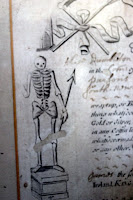
But what caught my eye among all this medieval ecclesiastical finery, were a set of small, framed black-and-white documents on the wall of the north aisle. These turned out to be 17th and 18thcentury certificates of "burial in shrouds made of wool". These rather macabre documents recall a period when it was a legal requirement to bury the dead in woollen shrouds, and of no other material.
 |
| Burial in Wool Affidavit: South Newington |
The certificates are decorated with symbols of death and mortality, including hourglasses, skeletons, coffins, a scythe, arrow, and bodies wrapped in shrouds.
The Burial in Woollen Acts 1666-80 were Acts of the Parliament of England which required the dead, except plague victims, to be buried in pure English woollen shrouds and never any foreign textiles. The driver for this restrictive practice was the perceived and real decline of the woollen industry throughout England. For centuries the woollen trade had been important to the wealth and prosperity of the country, but with the introduction of new materials and foreign imports, the wool business was under threat.
So, the idea was to create and to protect a new market for woollen cloth. It was a requirement that an affidavit be sworn in front of a Justice of the Peace (usually by a relative of the deceased or some other credible person) confirming burial in wool, with the punishment of a £5 fee for noncompliance. Parish registers were marked with the word affidavit or with a note 'A' or 'Aff' against the burial entries to confirm that affidavit had been sworn, or marked 'naked' for those too poor to afford the woollen shroud.
The declarations included the words: "No corpse of any person (except those who shall die of the plague) shall be buried in any shift, sheet, or shroud, or anything whatsoever made or mingled with flax, hemp, silk, hair, gold, or silver, or in any stuff, or thing, other than what is made of sheep’s wool only."
Failure to comply meant a fairly hefty £5 fine. Half of this money was paid to the informer. The other half was handed over to the Poor Fund of the parish where the body was buried. Within 8 days of the burial, an affidavit had to be provided declaring that the burial complied with the Act. The affidavit had to be sworn in front of a Justice of the Peace or Mayor by two worthy persons. If the parish did not have a JP or Mayor, the parson, vicar or curate could administer the oath.
This Act was obviously unpopular with many people as they wanted to buried in their finery as opposed to a cheaper garment or shroud in an off-white colour and of very thin material. And so here's a trick... Many were prepared to pay the £5, and a member of a family would become an informer so that in effect only half of the fine would be paid.
This concern at being buried in wool can be found ridiculed occasionally in literature.
"Harkee, Hussy, if you should, as I hope you won't, outlive me, take care
I ain't buried in flannel; 'twould never become me, I'm sure.
 Richard Steele: The Funeral, a play 1700.
"‘Odious! in woollen! 'twould a saint provoke!’
(Were the last words that poor Narcissa spoke).
'No! let a charming chintz and Brussels lace
Wrap my cold limbs, and shade my lifeless face"
Pope: Moral Essays, Ep. I.
Narcissa was a Mrs. Oldfield, an actress, who died 1731. Pope wrote this after reading that she was buried in "a Brussells lace head dress; a Holland shift with tucker and double ruffles of the same lace, and a pair of new kid gloves."
The Act was repealed in 1814, but was generally ignored after 1770.


